1. What Is Beef Aging?
After slaughter, beef does not immediately reach its optimal eating quality. Muscle tissue must undergo a process of self-degradation before the meat becomes tender and its flavor becomes richer. This process is called "aging."
From a biochemical perspective, the core of aging is the continuous activity of the beef's own natural enzymes. After slaughter, calpains and cathepsins in the muscle gradually break down muscle fibers and connective tissue, naturally tenderizing the meat. At the same time, proteins and fats are broken down into small molecules such as free amino acids and volatile fatty acids, giving the beef a more savory taste and a distinctive aroma. This process not only improves tenderness and juiciness but also significantly enhances the beef's flavor complexity.
Aging is not simply "letting meat sit until it tastes off." It is a precise, enzyme-driven biochemical process conducted under strictly controlled temperature and humidity conditions.
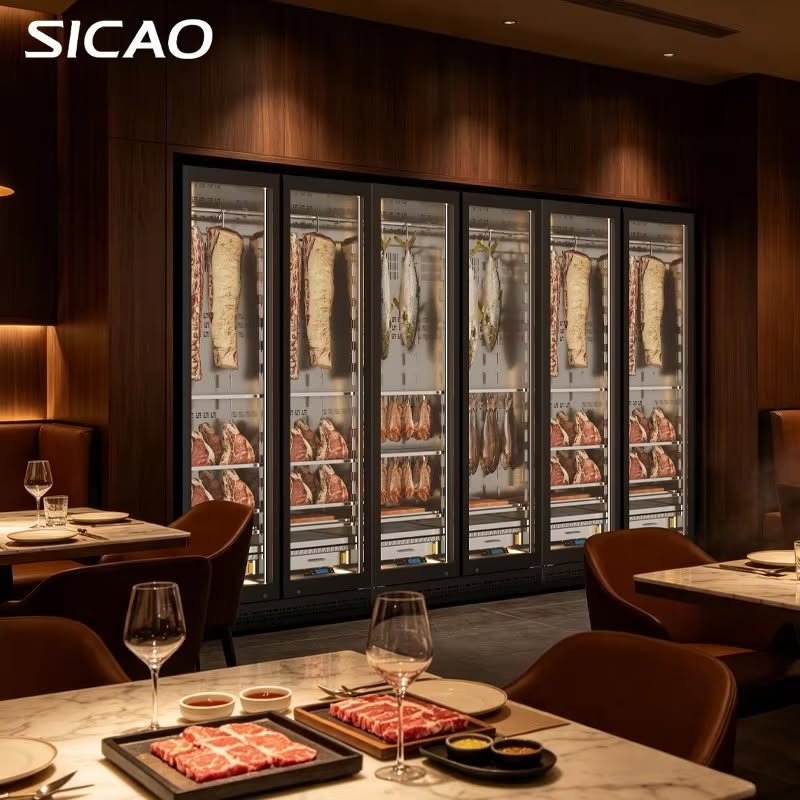
The two mainstream commercial aging methods are dry aging and wet aging. Their most fundamental difference lies in whether the beef is directly exposed to the external environment.
Wet aging places vacuum-sealed beef in a low-temperature environment. Almost no moisture is lost, and the yield can exceed 90%. However, because the packaging acts as a barrier, moisture on the beef's surface cannot readily escape, making off-flavors more likely and limiting flavor improvement.
Dry aging places whole cuts of beef uncovered in a clean environment with constant temperature, constant humidity, and a specific air velocity. The surface of the beef dries naturally to form a crust, sealing in internal juices while allowing natural enzymes to work fully. Dry-aged beef has a far superior flavor to wet-aged beef, but because the surface crust must be trimmed away before consumption and moisture evaporates, the yield is typically less than 60%. This is also why dry-aged beef is more expensive.
Dry aging imposes extremely strict requirements on environmental control. According to internationally accepted standards, the ideal conditions for dry aging beef are: a product surface temperature of 0.5–3.0°C, a relative humidity of 75%–85%, and an air velocity of 0.2–0.5 m/s, with a maximum aging period of 35 days in a dedicated aging space.
None of these parameters can be neglected: too high a temperature accelerates spoilage, while too low a temperature inhibits enzyme activity; too high humidity encourages mold growth, while too low humidity causes excessive moisture loss and greater shrinkage; improper air velocity prevents the formation of an even drying film on the beef's surface.
Aging time is equally critical. At least 14 days are needed before a noticeable change in tenderness can be perceived, and more than 4 weeks are required to appreciate the complex flavors unique to dry aging. Common dry-aging periods range from 20 to 45 days. The longer the aging, the more intense the flavor, but the greater the loss.
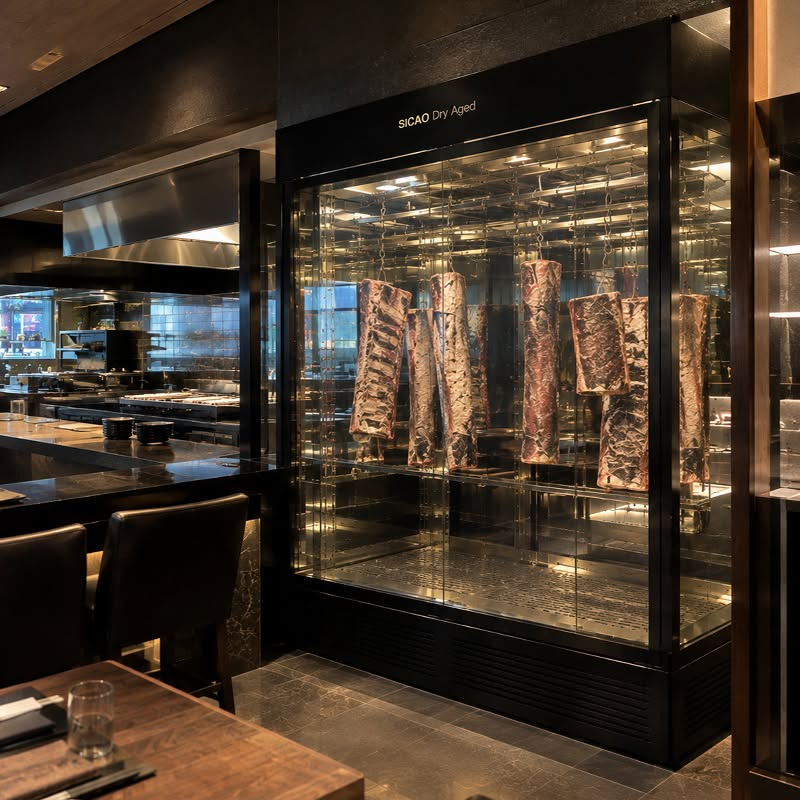
The most fascinating aspect of dry-aged beef is its flavor profile, which is completely different from that of fresh beef. Research shows that during aging, the content of umami amino acids such as free glutamic acid increases significantly, which is the core reason for the pronounced "umami" of aged beef. At the same time, volatile compounds produced by fat oxidation and protein degradation give dry-aged beef complex aromas such as nuttiness, creaminess, and cheesy notes. Academic studies describe its flavor characteristics as "a fusion of beefy notes, roasted aromas, buttery richness, nutty tones, and sweetness."
Simply put, aged beef does not need sauce to "rescue" its flavor—it is already impressive on its own.
A household refrigerator can have temperature fluctuations of 6–10°C, far from meeting the precise environmental control required for dry aging. A professional dry-aging cabinet is essentially a precise, clean, constant-temperature and constant-humidity space. It must simultaneously address several core issues:
Precise temperature control: Even a fluctuation of only 1–2°C can affect enzyme activity or increase microbial risk. Precise humidity control: Maintaining a humidity range of 75%–85% ensures normal enzyme activity while inhibiting harmful microorganisms. Even airflow: Continuous, gentle air circulation ensures an even drying film forms on the beef's surface. Microbial management: Measures such as UVC antibacterial treatment safeguard food safety during aging.
Since 2015, SICAO has invested in research and development of dry-aging technology. Its aging cabinets have been granted national invention patents, breaking through multiple technical barriers in temperature and humidity control, air velocity, and microbial management. Take the flagship model DA400S as an example: its wide temperature control range of 1–22°C and humidity adjustment range of 50%–85% can meet the aging needs of different ingredients. The DA400S Pro, equipped with the Smart Aging intelligent aging system, allows one-touch selection of aging modes for beef, poultry, fish, cheese, and more via a 5.2″ smart control screen. Users can also customize parameters based on personal experience. Combined with precise temperature and humidity control, wraparound even airflow, and UVC antibacterial technology, it makes professional-grade dry aging simple and controllable.
At present, SICAO aging cabinets have been used in more than 3,000 high-end restaurants, hotels, and mid-to-high-end butcher shops worldwide, turning the concept of "making professional aging technology accessible to all" into reality.
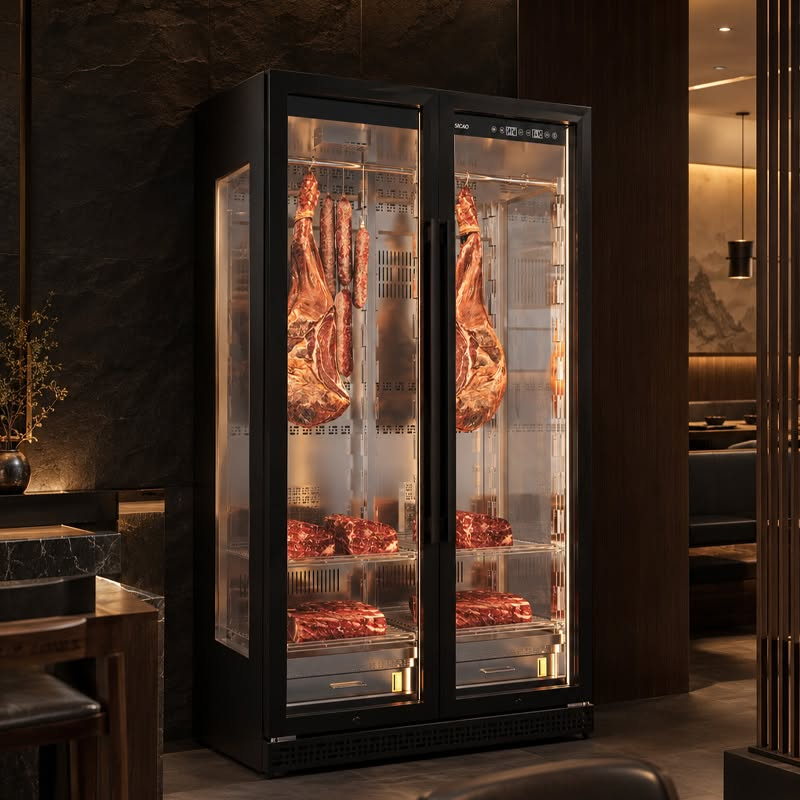
When choosing an aging cabinet, it is advisable to focus on the following dimensions:
Temperature and humidity control accuracy is the first core consideration. The smaller the temperature fluctuation, the more stable the aging quality. Airflow design determines the quality of the drying film formation and requires continuous, even air circulation. Antibacterial system is the baseline for food safety, and UVC sterilization is an industry-standard solution. Inner chamber material should preferably be food-grade 304 stainless steel to avoid absorbing oils and odors. Capacity and shelving should be selected according to the actual usage scenario; the needs of home and commercial users differ significantly.
Is aged beef safe? Under strict temperature and humidity control and microbial management, dry aging is safe. The key is whether the equipment can continuously maintain a surface temperature of 0.5–3.0°C, a relative humidity of 75%–85%, and an air velocity of 0.2–0.5 m/s.
Is longer aging always better? Not necessarily. Flavor changes are most dramatic within 21 days. Around 30 days, a good balance between flavor and tenderness is achieved. Beyond 45 days, costs rise sharply and excessive concentration may occur. It is recommended to choose an appropriate cycle based on personal taste preferences and equipment capability.
How should aged beef be cooked? It is recommended to cook it quickly over high heat, searing the surface to lock in juices while keeping the interior medium-rare to medium. Aged beef is already rich in flavor and requires little additional seasoning.


Address:12/F, Guowei E-Commerce Bld Guowei Road Luohu District Shenzhen China.
Tel:+86-755-82383909
Fax:+86-755-82383797
E-Mail:niti@cnsicao.com
whatsapp:+86-18924648232